

Best Practices in Writing Instruction
Writing Like Readers, Reading Like Writers
Nicole Godard · HCSS Best Practices
Over the last decade, I have tried every trick in the book to help demystify the complex work of writing for my students. Graphic organizers, sentence frames, miscellaneous acronyms… I’ve tried them all. Students would dutifully attempt to give me what I asked for. They’d fill out the hamburger-shaped organizer — The introduction goes in the top bun, your first claim in the lettuce… — and turn in uninspired and identical fill-in-the-blank arguments. We’ve all been there, I think. We know what good writing looks like, somehow we’ve managed to master it ourselves, but it seems impossible to help students internalize the shape of it, let alone produce it themselves.
The turning point for me came after, in a poetry unit, I asked students to play around with Billy Collins’ “Litany.”
You are the bread and the knife,
the crystal goblet and the wine.
You are the dew on the morning grass
and the burning wheel of the sun.
You are the white apron of the baker,
and the marsh birds suddenly in flight.

However, you are not the wind in the orchard,
the plums on the counter,
or the house of cards.
And you are certainly not the pine-scented air.
There is just no way you are the pine-scented air.
In what was meant to be an activity aimed at teaching students to analyze a poem for specific connotations, diction choices, and imagery, I asked students to try it themselves. “Pick someone you like – or don’t like. Following Collins’ format, write a poem that conveys that attitude with only word choice and imagery.”
What my students produced astounded me.
You are the first song on a new playlist,
the notification I was waiting for.
You are the window seat on a long bus ride
and the charger that still has juice.

You are the group project where I do everything,
the message left on read,
and the Android in the group chat.
Not every poem or line was especially brilliant, but every piece seemed to have just a little more life in it, a little more voice. Students took risks inside the structure and, entirely by accident, wrote poetry.
This, along with a lot of reading, writing, trial and error, let me to develop the approach to writing instruction that now dominates my classroom: offering a piece of real writing and saying, this is how a writer actually does it. Let’s see what we can steal.
That’s the animating idea behind mentor texts. And though I do encourage my students to steal, I don’t think of it as theft so much as apprenticeship. You find a piece of writing that does something beautifully — a sentence, a structure, a choice of word — and you hold it up to the light with your students. You ask: what do you notice? What can you name? And then, crucially: can you try it yourself?
Allison Marchetti and Rebecca O’Dell put it this way in Writing with Mentors: mentor texts “enable student writers to become connected to the dynamic world of professional writers” and, over time, build independence, so students can find and use craft in the writing they love on their own.
I’ve been using mentor texts in my ELA classroom for years, reaching for Yaa Gyasi when I want to teach the semicolon as something more than a grammar rule, or E.B. White when I want students to feel the difference between a concrete image and an abstract one. These are the bread and butter of the writing teacher’s practice, and the research backs the intuition: we learn to write by reading like writers, noticing the moves beneath the surface of the text.
But here’s what I’ve started to believe more firmly: mentor texts are not just an ELA strategy. They are a cross-curricular one.
✦
The Case for Cross-Disciplinary Mentor Texts
Every discipline has a way of writing — a set of moves, a preferred vocabulary, a relationship between evidence and claim. And every discipline, therefore, has mentor texts waiting to be used. The question is whether we treat those texts as objects to read or as models to imitate.
Jeff Anderson writes in Mechanically Inclined that the best grammar instruction happens when we “let examples do the work,” when we let Gary Paulsen show students about active verbs, or let Patricia MacLachlan show them how phrases can tumble off the ends of sentences. It stands to reason, then, that for other kinds of instruction, the principle remains the same: Let the text teach!
Consider what happens when a social studies teacher pauses on a single sentence from Dee Brown’s Bury My Heart at Wounded Knee — not to simply to comprehend it, but to interrogate the impact of the author’s language on the historical rendering:
That is a writing lesson and a history lesson at once. The craft question and the content question are the same question.
Kelly Gallagher has written about how vocabulary acquisition works best when words are encountered in context, embedded in real reading, rather than memorized in isolation. A science classroom that pauses on a single sentence — why did the textbook writer say generate instead of create? — is doing exactly that work:
The same logic applies in math. A word problem is a mentor text. Before students pick up a pencil to solve, ask them to read it once without solving and then circle every word that mathematically matters, define each term in their own words, and ask: how does each word help me understand what’s being asked?
✦
Mentor Texts From All Ages — Including 1750 BCE
One of my favorite moves is introducing students to the oldest known complaint letter in the world, a cuneiform tablet discovered in ancient Mesopotamia, written by a merchant named Nanni to a copper dealer named Ea-Nāṣir, who apparently sold him inferior goods and then refused to make it right. The tablet is approximately 3,800 years old. And it reads, structurally, exactly like a strongly worded email.
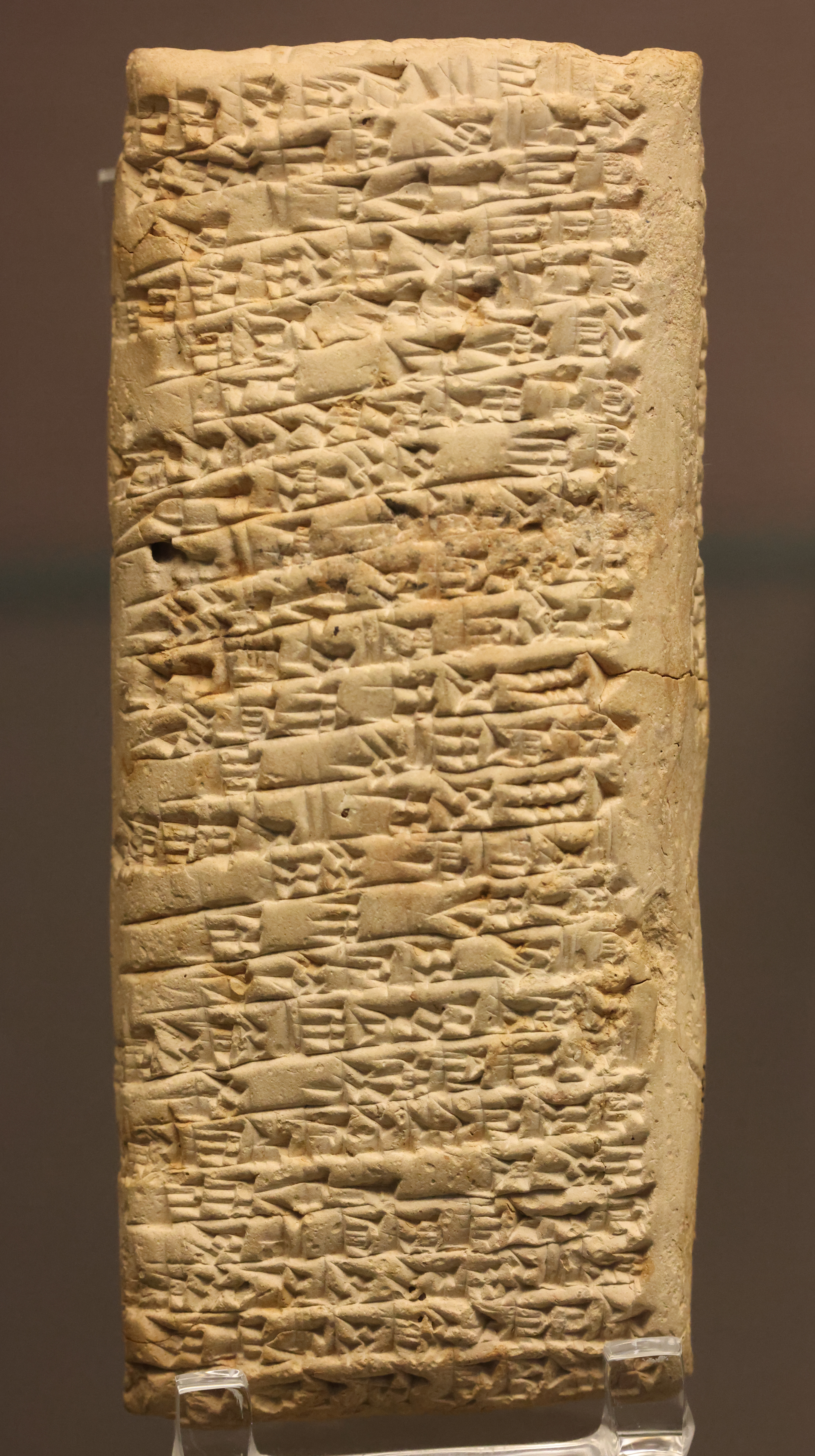
A note on range
Marchetti and O’Dell remind us that good mentor texts can come from anywhere — newspapers, magazines, literary fiction, pop culture, the internet. I’d add: also ancient Mesopotamia. The range of possible mentors is limited only by our willingness to read widely and ask, of anything, how did they do that?
What students write when given this kind of exposure consistently surprises me. A student once read Cormac McCarthy’s description of a terrain where no one thing nor spider nor stone nor blade of grass could put forth claim to precedence, spent time with the word austerity, and wrote: “Austerity is an attitude you have. The terrain isn’t just empty, it’s empty on purpose.” That is a student thinking — actually thinking — about how language makes meaning.
That kind of thinking is available in every classroom. The framework I use breaks down into three scales: words, sentences, and passages. At the word level, mentor texts teach students that vocabulary is not a list to memorize but a set of choices writers make deliberately. At the sentence level, they show students that grammar is a toolkit to deploy. At the passage level, they help students see the architecture of good writing: how an argument builds, how a scene earns its emotional payoff, how an explanation moves from the general to the specific.
“Mentor texts enable all of us — teachers and students alike — to do far more than we could ever do on our own.”
— Allison Marchetti & Rebecca O’Dell, Writing with Mentors
✦
How to Begin
If you’re not already using mentor texts in your classroom, start small: one sentence, one paragraph, once a week. Read it aloud. Ask what students notice. Let the text do the teaching. The framework is simple — read, notice, name, imitate — and the entry point is wherever you already are.
You don’t need to be an English teacher. You need a piece of writing that does something worth studying, and the willingness to ask: how did they do that?
Works Referenced
Anderson, Jeff. Mechanically Inclined. Stenhouse, 2005.
Marchetti, Allison & Rebecca O’Dell. Writing with Mentors. Heinemann, 2015.
Gallagher, Kelly. Readicide. Stenhouse, 2009.